
What's your
Fitzpatrick skin type?
Answer 8 quick questions to find your type, I through VI, then get a sun-care routine and product picks for what you actually came for: stopping sunburn, getting color without the burn, fading dark spots and melasma, or finding a sunscreen that leaves no cast on deep skin.
The Fitzpatrick skin type test tells you whether your skin is Type I through VI by how it burns and tans, so you can pick sun care and products that actually fit.
Loading the test...
As an Amazon Associate this site earns from qualifying purchases. Picks are chosen on fit, not commission.
✓ Do this
✕ Avoid this
Recommended for your skin
Product types that suit your Fitzpatrick type, so you can grab whichever brand you already trust.
The Fitzpatrick scale sorts skin by how it reacts to the sun
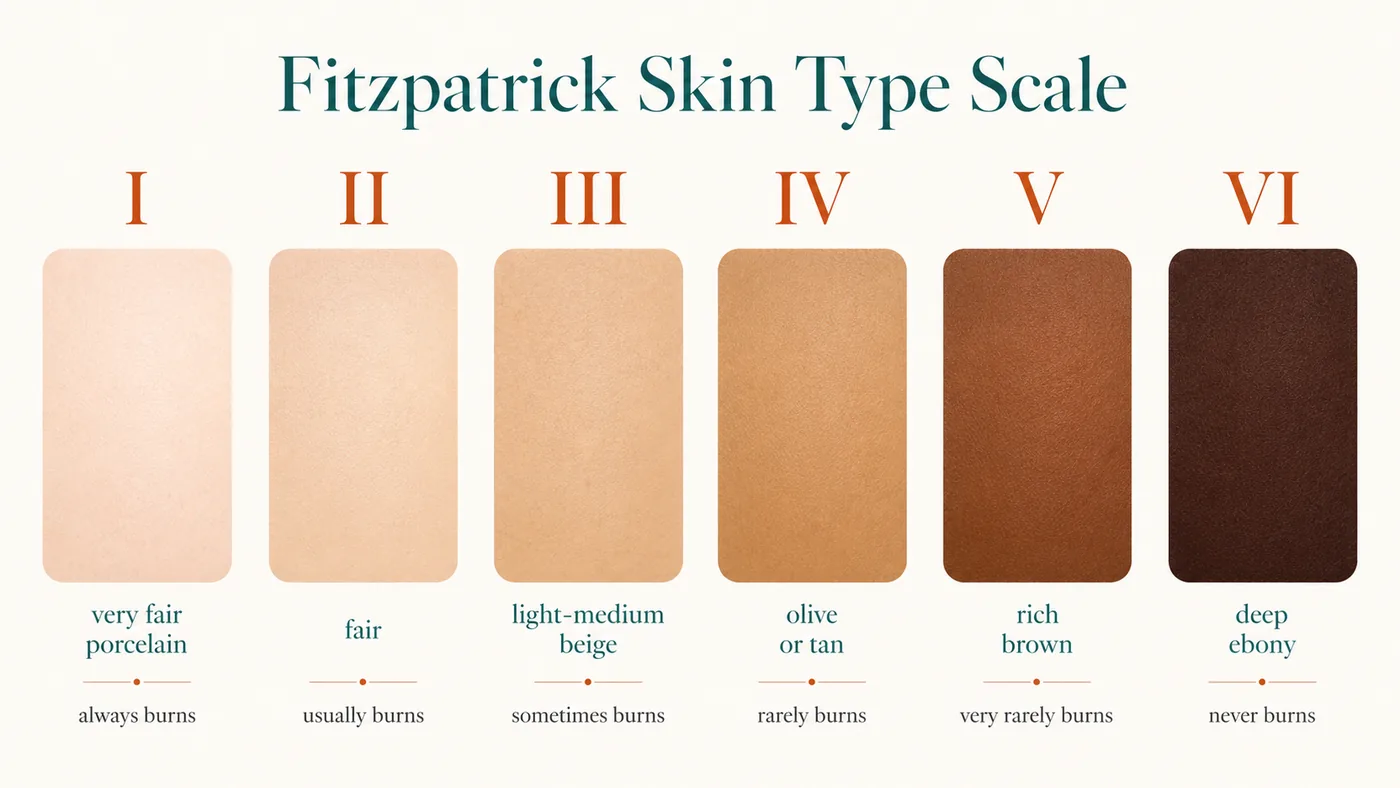
Developed in 1975 by dermatologist Thomas Fitzpatrick, the scale groups skin into six phototypes (the clinical term for skin types) by two simple things: how easily it burns and how readily it tans. Knowing yours is the fastest way to choose sun care and products that actually fit. And every type on the scale, including the deepest, benefits from daily sunscreen.
Type I
Always burns, never tans. The fairest skin, with the least natural sun defense.
Type II
Usually burns, tans minimally. Fair skin that can build only a faint, costly tan.
Type III
Sometimes burns, tans gradually. The middle of the scale, with a bit more give.
Type IV
Rarely burns, tans easily. A warm, golden base prone to uneven tone.
Type V
Very rarely burns, tans very easily. Deepening skin where dark spots are the concern.
Type VI
Never burns, deeply pigmented. Still needs SPF, for even tone and hyperpigmentation.

One scale, six types, and advice that fits yours
Most sun-care advice is written for one kind of skin. The Fitzpatrick scale covers all of it, from the fairest skin that burns in minutes to the deepest skin fighting stubborn dark spots. Every routine and every product pick on this site is matched to one of the six types, so the advice you get is written for your skin, not the average of everyone else's.
Not sure where you land? The test takes under a minute, and you can always place yourself by hand.
Guides for whatever your skin is dealing with
Sunburn, dark spots, melasma, white cast, foundation match: once you know your Fitzpatrick type, these walk you through exactly what to do next.
Fitzpatrick skin type questions, answered
What is the Fitzpatrick skin type scale?
The Fitzpatrick scale, developed in 1975, sorts skin into six phototypes (Type I to Type VI) by how it reacts to sun: how easily it burns and how readily it tans. Type I is the fairest and always burns, Type VI is the deepest and effectively never burns. It is a tool for understanding sun reaction and choosing sun care, not a measure of beauty or a medical diagnosis.
How accurate is an online Fitzpatrick test?
This quiz uses the same self-assessment questions the original scale is based on: eye color, natural hair color, unexposed skin color, freckling, and how your skin burns and tans. It gives a reliable estimate of your phototype for choosing sun care. For any medical skin concern, see a dermatologist, who can assess your skin in person.
Is my Fitzpatrick type the same as my skin tone?
Not exactly. Skin tone describes how your skin looks; your Fitzpatrick type describes how it behaves in the sun. They usually line up, fair skin tends to be Type I or II and deep skin Type V or VI, but two people with a similar tone can burn and tan differently, which is what the type captures.
What skin type are most people?
Worldwide, Type III and Type IV are the most common phototypes: medium to olive skin that tans fairly easily and burns only after real overexposure. In the United States, Type II and Type III dominate. Whatever the averages say, sun care is individual, which is why the test asks about your burn history rather than your background.
What Fitzpatrick type is olive skin?
Olive skin is usually Fitzpatrick Type IV: skin with a green-yellow undertone that tans easily and rarely burns. Lighter olive complexions that catch the occasional burn can land at Type III instead. The tell is behavior, not color alone, so note how your skin handled its last strong sun exposure before settling on a type.
Can my Fitzpatrick skin type change?
Your underlying phototype, set by genetics, stays the same through life. What changes is how tanned or sun-exposed your skin is at a given moment, which can make it look like a different type temporarily. Base your routine on your natural, unexposed skin.
Does darker skin really need sunscreen?
Yes. Deeper skin, Type V and VI, burns less easily but is still affected by the sun, especially through hyperpigmentation and uneven tone. Daily broad-spectrum sunscreen, ideally one that leaves no white cast, is the most effective way to keep deep skin even and healthy.
What SPF should each Fitzpatrick type use?
SPF 30 broad-spectrum, worn daily, is the floor for every type on the scale. Type I and II should prefer SPF 50, since fair skin burns fastest and has the least natural defense. Deep skin still needs the daily SPF 30: melanin's built-in protection is estimated at around SPF 13 at best, well below what a bottle provides.
Which skin type gets melasma the most?
Melasma shows up most in Types III to V: medium, olive, and brown skin, where pigment cells respond strongly to hormones and light. It is also more common in women, and heat and visible light can deepen it, not just UV. A tinted mineral sunscreen with iron oxides blocks the visible light plain SPF lets through.
Is the Fitzpatrick scale still used by dermatologists?
Yes. Dermatologists still use the Fitzpatrick scale daily to set laser and light-treatment settings, estimate sunburn and skin cancer risk, and dose phototherapy. Its limits on deeper skin tones are well known, which is why newer tools like the Monk scale supplement it, but after five decades it remains the standard phototype reference.
Do you store my answers?
No. The quiz runs entirely in your browser. Nothing is sent anywhere, and there is no account or email required to see your result.
Why does the Fitzpatrick scale matter for choosing products?
Your type predicts what your skin needs. Fair types need maximum sun protection and self-tanner for color; olive and brown types need no-cast SPF and brightening for even tone; deep types need invisible SPF and dark-spot care. Knowing your type is the fastest way to stop guessing at the shelf. Once you know yours, our buying guides do the sorting for you, starting with the best sunscreen for dark skin.
Find the routine your skin actually needs
Under a minute now saves months of buying sunscreen that casts gray, self-tanner that turns orange, or foundation that never quite matches.
Take the free test