
The best moisturizer for dark skin, with no ashiness
Ashiness is not dirt and it is not you doing skincare wrong. It is dryness catching the light. Here are the moisturizer types that keep deep skin hydrated, even, and luminous without turning greasy, the ingredients that actually beat ash, and how to layer them so it lasts all day.

Why deep skin looks ashy, and what actually fixes it
If you have deep, Type V or Type VI skin, you know the ashy gray film that shows up on your shins, elbows, knuckles, and sometimes your face by the afternoon. It is the single most common complaint people with dark skin bring to a moisturizer, and it is worth being clear about what it is, because the internet is full of bad theories.
Ashiness is dryness made visible. Every skin tone constantly sheds dead surface cells; those cells are pale, and they catch the light. On fair skin the pale flakes blend into a pale background and nobody notices. On rich, deep skin the same pale flakes contrast sharply against the deeper tone, so they read as gray, chalky, or ashy. It is not dirt, it is not poor hygiene, and it does not mean you are doing something wrong. It simply means the surface is dry and shedding faster than it is being softened and sealed.
That reframes the fix. You do not beat ashiness by scrubbing harder, which usually makes it worse by stripping the barrier. You beat it two ways: gentle exfoliation to smooth the surface, and, far more importantly, hydration that stays sealed in. The reason a lotion works for an hour and then the ash comes back is almost always that the water evaporated because nothing locked it down. A good moisturizer for deep skin does both jobs at once: it pulls water in, and it seals it so it stays.
The other thing deep skin needs from a daily moisturizer is help keeping tone even and luminous. Deep skin is especially prone to hyperpigmentation, dark spots, and post-acne marks, so the best moisturizers here often carry a barrier-supporting, tone-evening ingredient like niacinamide. Hydrated skin also simply looks more even and glowing than dry skin does, so consistent moisture is quietly the first step in an even complexion.
How we judge a moisturizer for deep skin
Most "best moisturizer" lists are written for the average complexion and treat ashiness as an afterthought. We put it first. Every type below earns its place against the things that actually matter on Type V and VI skin, judged the way you would judge it living with it, not in a lab.
What we look for in a deep-skin moisturizer
These are the four checks a moisturizer has to pass for a no-ash guide, because a product can pass one and fail the rest:
1. The end-of-day check. Does the skin still look hydrated and even hours after applying, or has the ash crept back? A moisturizer that only works for an hour is not sealing moisture in. This is the check that separates a real ash-beater from a quick fix.
2. The no-grease check. Does it absorb and leave skin looking like healthy skin, or does it sit as a slick film? Deep skin should look luminous, not oily. The right richness for your skin type is what gets this right.
3. The even-tone check. Does it support the barrier and help with the dark spots and uneven patches deep skin is prone to, or is it purely surface hydration? Ingredients like niacinamide earn extra credit here.
4. The layering check. Does it play nicely under sunscreen and makeup in the morning without pilling or turning gray? A face moisturizer for deep skin has to be a team player.
Recommendations are by product type and what to look for, so you can choose whichever brand you already trust, not whichever pays the most.
Moisturizer types that actually work on dark skin
Rather than crown one "winner," it helps to know the categories, because the right one depends on your skin and where on your body you are treating. Here are the types that consistently keep deep skin even and ash-free, with the job each does best and what to look for.
1. Daily face cream with glycerin and ceramides (the everyday default)
The job: a lightweight daily face moisturizer that hydrates and seals in one step, absorbs clean, and layers under sunscreen. This is the one most people with deep skin should reach for every morning and night. Glycerin pulls water in; ceramides and a light emollient seal it, so you stay hydrated past midday instead of going ashy.
What to look for: glycerin and ceramides high on the ingredient list, a cream or lotion texture that is not heavy, and ideally added niacinamide for tone. Fragrance-free is the safer bet for reactive deep skin.
Budget alternative: a drugstore ceramide moisturizing cream. The classic barrier creams are inexpensive, fragrance-free, and beat ash as well as products many times the price.
2. Rich shea or cocoa butter body cream (the heavy-duty ash-beater)
The job: deep, lasting hydration for the body, and especially for the classic dry zones: shins, knees, elbows, and knuckles. Shea and cocoa butter are the traditional ash-beaters for a reason. They are rich emollients that soften and seal, and on deep skin they leave a healthy sheen rather than a gray film.
What to look for: shea butter or cocoa butter near the top of the list, ideally paired with a humectant like glycerin. A cream or body butter texture for winter and very dry skin; a shea lotion for everyday.
Budget alternative: a tub of raw or minimally processed shea or cocoa butter. Inexpensive, one ingredient, and unbeatable on genuinely dry patches.
3. Lightweight gel-cream or lotion (for oily deep skin and humid weather)
The job: hydration without heaviness, for people whose deep skin runs oily, or for hot and humid climates where a rich cream feels like too much. A gel-cream or light lotion delivers water and light sealing without the greasy slick, so you stay matte and even, not shiny.
What to look for: "gel-cream," "oil-free," or "lightweight" on the label, with hyaluronic acid or glycerin for hydration and niacinamide to help balance oil and even tone. Non-comedogenic if you are acne-prone.
Budget alternative: a drugstore oil-free gel moisturizer with hyaluronic acid. Light, cheap, and ideal for oily deep skin.
4. Rich barrier cream or ointment (for very dry and eczema-prone deep skin)
The job: maximum sealing for very dry, tight, or eczema-prone skin, and for the coldest, driest months. When a normal lotion is not enough and the ash keeps returning, a thick barrier cream or ointment locks moisture down hard. Best on the body or applied thinly at night.
What to look for: ceramides plus occlusives, a thick balm or ointment texture, fragrance-free, and a "repairs dry skin barrier" or "for eczema-prone skin" claim. Apply to damp skin for the strongest effect.
Budget alternative: a classic healing ointment or a drugstore barrier repair balm. Cheap and extremely effective on cracked, ashy dry patches.
5. Moisturizer with SPF (the two-in-one morning step)
The job: hydration and sun protection folded into one morning step, so you never skip the SPF that deep skin most needs for even tone. Sun exposure is the biggest driver of the dark spots and uneven patches deep skin is prone to, so a hydrating daily moisturizer with broad-spectrum SPF quietly does two of the most important jobs at once.
What to look for: broad-spectrum SPF 30 or higher, a "no white cast" or "invisible" claim written for deep skin, plus glycerin for hydration. If you want the details on cast-free SPF, see our best sunscreen for dark skin guide.
Budget alternative: a lightweight drugstore daily SPF moisturizer in a formula that dries clear on deep skin.
If you can only buy two
Get a daily face cream with glycerin and ceramides for your face, the one you will use morning and night, and a rich shea or cocoa butter body cream for the body and the dry zones that ash the fastest. Those two cover the vast majority of deep-skin situations. Add a lightweight gel-cream later if your skin runs oily or you live somewhere humid, and a moisturizer with SPF if you want to fold sun protection into your morning. Two products, used consistently on damp skin, beat a shelf of half-used jars.
Ingredients to look for, and to be careful with
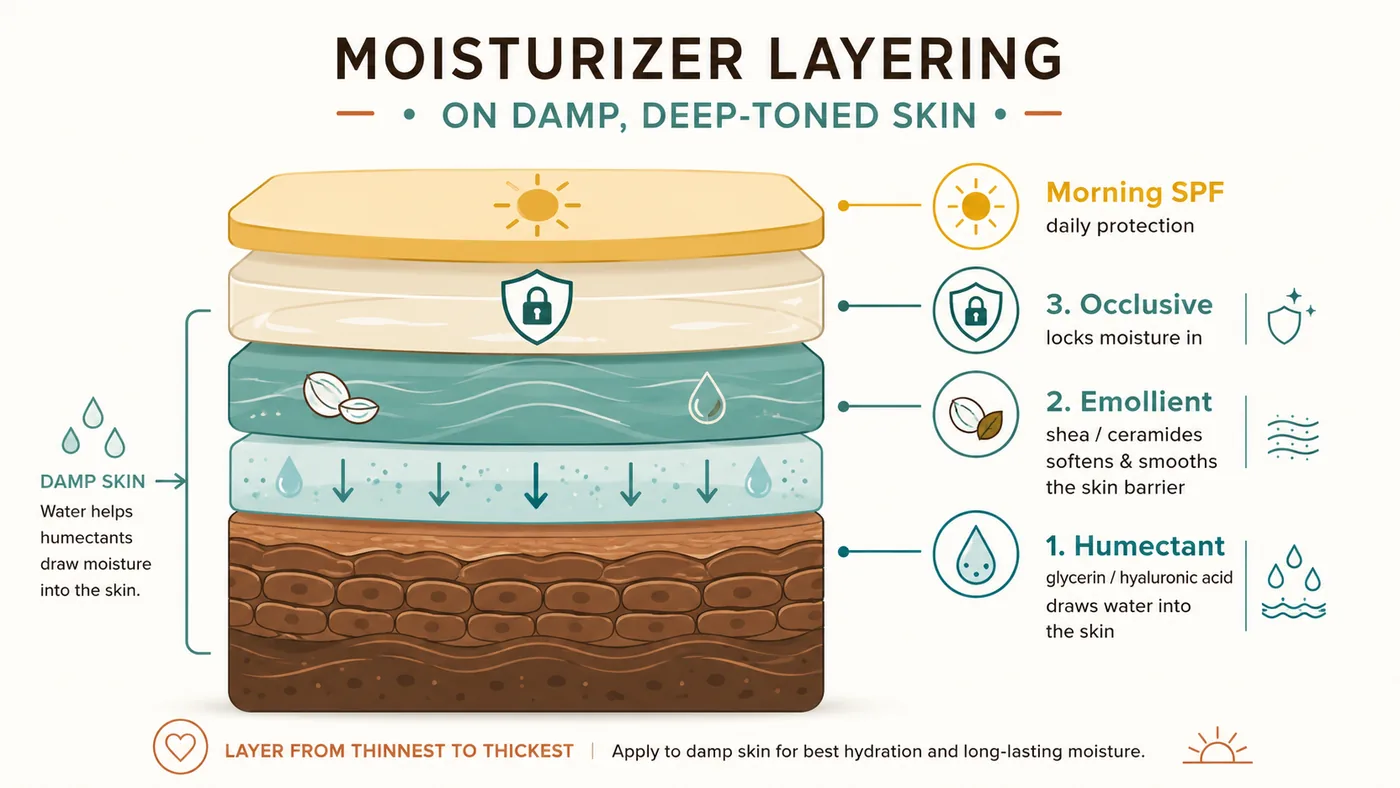
You do not need a chemistry degree, but a few label cues sort the real ash-beaters from the products that hydrate for an hour and quit. Think of a good moisturizer as three jobs: pull water in, soften, and seal it.
Look for:
- Humectants: glycerin and hyaluronic acid. These pull water into the skin and are the hydration engine of any good moisturizer. Glycerin is the workhorse, inexpensive and reliable, and it belongs near the top of the list.
- Emollients: shea butter, cocoa butter, squalane. These soften and smooth the surface, filling the gaps between shedding cells so light stops catching them as ash. Shea and cocoa butter are the deep-skin classics.
- Ceramides and occlusives to seal. Ceramides rebuild the barrier so moisture stops escaping. This is the piece most cheap lotions skip, and it is exactly why they stop working by midday.
- Niacinamide. A strong bonus for deep skin: it supports the barrier and helps even tone and fade the dark spots and post-acne marks deep skin is prone to. A moisturizer that hydrates and evens tone is doing double duty.
Be careful with:
- High alcohol content (alcohol denat. high on the list). Drying alcohols can strip the barrier and make ashiness worse, especially on already-dry deep skin.
- Heavy fragrance on reactive skin. Fragrance is a common irritant, and irritation on deep skin can leave dark marks. Fragrance-free is the safer default if your skin reacts easily.
- Thick pore-clogging balms on an oily, acne-prone face. The rich butters that beat ash on your shins can clog pores on an oily face. Match the richness to the area: light on an oily face, rich on dry body skin.
- Over-exfoliating. Scrubs and strong acids used too often strip the surface and worsen the very dryness that causes ash. Gentle and occasional beats harsh and frequent.
One note on tone-evening actives: melasma and stubborn dark patches are often hormone-driven, and anyone pregnant or nursing should check with their doctor before starting new active ingredients like niacinamide or tranexamic acid.
How to layer moisturizer so it lasts all day
The right product still fails if you use it wrong, and the most common mistake is applying moisturizer to bone-dry skin. Here is how to get the most out of whatever you choose.
Moisturize damp, not dry. The best time to apply is straight after a shower or after splashing your face, while the skin is still slightly damp. The moisturizer then traps that existing water instead of sitting on top as a slick. This one change is the difference between hydration that lasts and ash that returns by lunch.
Layer light to heavy. If you use a hydrating serum or a humectant like hyaluronic acid, it goes on first, onto damp skin, then your cream or butter seals it. Water-based before oil-based, thin before thick.
Match richness to the zone. Use a lighter gel-cream or lotion on the face and any oily areas, and save the rich shea or cocoa butter for the shins, elbows, knees, and knuckles that genuinely need it. Using one thick product everywhere is what makes an oily face look greasy.
Seal in the morning with SPF. After your face moisturizer, finish with a broad-spectrum sunscreen. Sun exposure is the biggest driver of the uneven tone and dark spots deep skin is prone to, so the morning moisturize-then-protect step is the highest-value thing you can do for an even complexion. If dark spots are your main concern, our guides on dark spots on dark skin and the best sunscreen for dark skin go deeper.
Do not forget the ash-prone edges. Elbows, knees, shins, knuckles, heels, and the tops of the feet are where deep skin ashes first and worst, because they are drier and get missed. Give them the richest product and the most attention.
The picks
Below are representative products for each type above. We link to Amazon searches, not single listings, so you land on current options and pricing rather than a stale page, and so you can pick the brand you already trust within each category.
How we choose: picks are selected editorially to fit deep, Type V and VI skin, based on formula, finish on deep skin tones, and reputation. No brand pays for placement. As an Amazon Associate this site earns from qualifying purchases, at no extra cost to you; links open a search so you see current options.
Not sure you are Type V or VI?
This guide is written for deep, Type V and VI skin, but if your skin lands a shade lighter you may get more from an olive or medium routine. The fastest way to know is to check where you fall on the scale. Take the free Fitzpatrick test →
Questions, answered
Why does dark skin look ashy?
Ashiness is dead skin cells and dryness catching the light as a gray or white film. Every skin tone sheds dead cells, but on deep, Type V and VI skin the pale flakes contrast against the rich background and read as ash, where on fair skin they blend in and go unseen. It is not a sign of dirt or poor hygiene. It is simply dryness made visible, which is why the fix is hydration that stays sealed in, plus gentle exfoliation, not scrubbing harder.
What is the best moisturizer for black and dark skin?
The best moisturizer for deep skin is one that pairs a humectant like glycerin or hyaluronic acid, which pulls water in, with an emollient like shea butter or an occlusive that seals it, so the hydration does not evaporate and leave you ashy again by midday. For the face, a glycerin-and-ceramide cream works for most people. For the body, a shea or cocoa butter lotion or cream is the classic ash-beater. Match the richness to your skin: lighter for oily deep skin, richer for very dry.
What ingredients stop ashiness on deep skin?
Look for humectants (glycerin, hyaluronic acid) to draw water in; emollients (shea butter, cocoa butter, squalane) to soften and smooth; and occlusives or ceramides to seal moisture so it does not escape. Niacinamide is a strong bonus for deep skin because it supports the skin barrier and helps even tone and fade dark spots. Together these keep skin hydrated long enough that the ashy gray film never forms.
Is shea butter or a lotion better for dark skin?
Both, for different jobs. A shea or cocoa butter cream is the heavy-duty ash-beater for very dry body skin, elbows, knees, and shins, and for winter. A lighter lotion or gel-cream is better for the face and for oily or humid-weather skin, where a thick butter can feel greasy or clog pores. Many people with deep skin use a light face moisturizer and a rich body butter, rather than one product for everything.
How do I moisturize dark skin without looking greasy?
Apply moisturizer to damp skin, straight after a shower or after splashing your face, so it locks in existing water instead of sitting on top as a slick. Use a lighter gel-cream or lotion on the face and any oily areas, and save the rich butters for genuinely dry spots. A little goes a long way; too much product, not the wrong product, is usually what causes the greasy look.
Does dark skin still need daily moisturizer?
Yes. Deep skin is not naturally more oily or self-hydrating, and it shows dryness more visibly as ash, so a daily moisturizer matters as much as it does for any skin. Consistency is what keeps tone even and luminous. Pair your moisturizer with a broad-spectrum sunscreen in the morning, since sun exposure is the biggest driver of the dark spots and uneven tone that deep skin is prone to.
Related guides
Sources
- American Academy of Dermatology, sunscreen FAQs
- Skin Cancer Foundation, skin cancer in people of color
This site is educational and is not medical advice; for any skin concern, see a board-certified dermatologist.