
Fitzpatrick Type II: the fair-skin sun-care guide
You go pink or red long before you ever see a tan, and what you actually want is either some color without paying for it in burns, or simply to stop burning at all. Both are fair asks, and both point to Type II: fair skin that usually burns before it manages a light tan, one of the two most sun-sensitive types on the scale. The right routine is mostly protection, with color, if you want any, coming from a bottle instead of the sun.
How to know if you are Type II
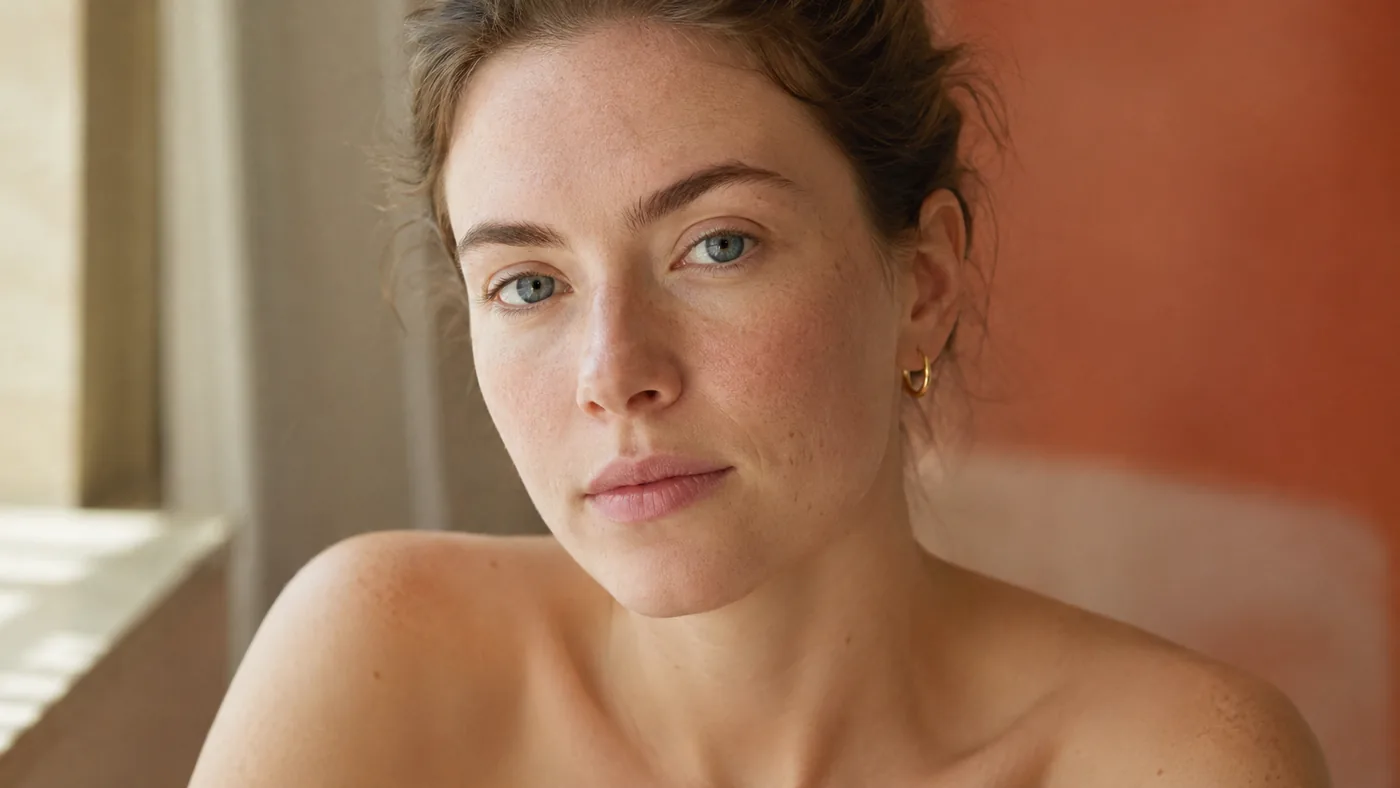
Fitzpatrick Type II is the second-fairest phototype (the clinical term for skin type). If you usually go pink or red in the sun and only ever build a faint, slow tan, you are probably here. It is the most common type in much of Northern Europe and among people of British, Irish, Scandinavian, and German descent, and it is the type a lot of people mean when they say they have "fair skin that just burns."
The original Fitzpatrick scale, built by dermatologist Thomas Fitzpatrick in 1975, sorts skin by two questions: how easily it burns, and how readily it tans. Type II answers "easily" and "barely." A few markers tend to travel with it:
- Skin tone: fair, often with a cool or neutral undertone. The skin the sun never reaches (your inner upper arm) looks pale ivory or light beige.
- Eyes: commonly blue, gray, or green, though hazel and lighter brown are possible.
- Natural hair: blonde, light brown, or sometimes auburn. Bright red hair leans more toward Type I.
- Freckles: some, especially after sun exposure, though not always as heavily as Type I.
- Sun history: you burn first, almost every time, and any tan that follows is light and fades fast.
Type II overlaps closely with Type I on one side and Type III on the other. The honest truth is that the line between Type I and Type II is fuzzy, and it does not change your routine much. If you are torn between the two, the safest move is to follow the slightly more cautious Type I advice; you cannot over-protect fair skin. The bigger gap is to Type III, which can take some sun and tan to a real light brown without burning first.
How Type II skin reacts to the sun
The defining feature of Type II is the order of events: burn first, faint tan maybe later. Where deeper types tan as their main response to UV, fair skin reddens. That redness is inflammation, the visible edge of sunburn, and it can show up after surprisingly little time outdoors, sometimes inside twenty to thirty minutes of strong midday sun with no protection.
Type II skin has less melanin, the pigment that absorbs and scatters UV, so more of that radiation reaches the living cells underneath and damages their DNA. A tan, when it eventually comes, is your skin trying to build a thin shield after the fact. It is real, but it is weak, the equivalent of roughly SPF 3 or 4, and it arrives only after damage has already been done. That is why dermatologists are blunt about it: there is no such thing as a safe tan for fair skin. Every shade of color is a record of harm.
Over years, that adds up in two ways that matter for Type II specifically. First, skin cancer risk: fair, easily-burned skin carries a higher lifetime risk of melanoma and other skin cancers, and a history of blistering sunburns raises it further. Second, photoaging: fine lines, sunspots, broken capillaries, and a leathery texture that shows up earlier on under-protected fair skin. The good news is that almost all of this is preventable, and protecting Type II skin is genuinely simple once it becomes a habit.
A note on what this page is
This is general guidance for choosing sun care, not medical advice, and the Fitzpatrick test is educational, not a diagnosis. If you have a mole that is changing, a spot that will not heal, or any skin concern, see a dermatologist, who can look at your skin in person.
The Type II sun-care routine
You do not need a fifteen-step regimen. For Type II skin, the routine is short and the order is what matters. Protection comes first; color, if you want it, comes from a bottle.
1. Daily broad-spectrum SPF 30 to 50
This is the whole game. Apply a broad-spectrum (UVA and UVB) sunscreen of at least SPF 30 every morning, all year, rain or shine. Step up to SPF 50 for any real time outdoors, days at the beach, at altitude, or near water and snow, which both bounce extra UV back at you. Use enough: about a quarter teaspoon for the face and neck alone, and a shot-glass amount for the whole body. Most people use a third of what they should, which quietly turns an SPF 50 into something far weaker.
2. Reapply, every two hours outdoors
Sunscreen wears off, sweats off, and rubs off. Outdoors, reapply every two hours, and immediately after swimming or toweling down, even with a "water-resistant" formula. For everyday indoor days a single morning application is usually fine; the reapply rule is for time actually spent in the sun.
3. Hat, sunglasses, and shade
Sunscreen is one layer, not the only one. A wide-brimmed hat shades the parts of the face that catch the most sun, UV-blocking sunglasses protect the thin skin around the eyes, and stepping into shade between roughly 10am and 4pm cuts your exposure when the sun is strongest. A UPF-rated hat or shirt is a quiet upgrade for fair skin, since it protects without needing reapplication.
4. Gradual self-tan for color
If you like having some color, get it from a self-tanner. Modern gradual formulas build slowly and read as a believable light golden tan rather than the orange of older products, which suits fair skin much better than a sudden deep shade. It gives you the look without the burning, the aging, or the cancer risk that come with chasing a real tan. Self-tan offers no sun protection, so you still wear your SPF on top.
What to look for in products
You do not need a specific brand. You need a few specific traits, and then any product you already trust that has them will do. Here is what actually matters for Type II skin.
- Broad spectrum, SPF 30 or higher. The label must say "broad spectrum" so you are covered for UVA (aging, year-round) as well as UVB (burning). For fair skin, 30 is the floor and 50 is better for time outdoors.
- A texture you will actually wear daily. The best sunscreen is the one you reapply without dreading it. Lightweight lotions and fluids suit most people; if you hate the greasy feel, look for a "dry-touch" or gel formula.
- Mineral if your skin is reactive. Fair skin is often sensitive too. Mineral filters (zinc oxide, titanium dioxide) are gentle and good for the face, though older ones can leave a faint white cast. Chemical filters tend to feel lighter and rub in clear. Either protects you; pick by feel.
- Self-tanner labeled "gradual" or "for fair skin." A lower concentration of the active (DHA) builds color in believable steps and is far more forgiving of streaks than a one-coat dark mousse.
- An after-sun with aloe or panthenol. For the days you catch a little too much sun, a cooling, hydrating lotion calms the skin and helps it recover. It treats the symptom, not the damage, so it is a backup, not a substitute for not burning.
Common mistakes to avoid
Most sun damage on fair skin comes from a handful of avoidable habits. If you only fix these, you fix most of it.
- Chasing a deep tan. The biggest one. Type II skin cannot safely tan deeply; it burns trying. A "base tan" before a holiday is a myth that just front-loads the damage. Use self-tanner for color and stop asking your skin to do something it cannot do safely.
- Missing the ears, neck, and hands. These are the spots fair skin most often forgets and where sun damage shows up first. The tops of the ears, the back and sides of the neck, the hairline, and the backs of the hands all need the same SPF as your face.
- Forgetting the lips and the eye area. Lips have little melanin and burn easily; use an SPF lip balm. The thin skin around the eyes ages fast, so sunglasses are protection, not just style.
- Skipping cloudy and winter days. Up to 80 percent of UV gets through cloud, and UVA is steady all year and passes through window glass. Daily is daily.
- Under-applying and not reapplying. Too thin a layer or a single morning coat that has to last a beach day both leave you exposed. Use enough, then top up every two hours outdoors.
- Treating self-tan as protection. A self-tan looks like color but blocks no UV. Always wear real sunscreen on top.
Products that work for Type II
These are product types chosen for how they fit fair skin, described so you can pick whichever brand you already trust. Each card has a representative pick and a budget alternative.
As an Amazon Associate this site earns from qualifying purchases. Picks are chosen on fit for Type II skin, not on commission. This is general guidance, not medical advice.
- Broad spectrum SPF 50, the non-negotiable for Type II
- Fragrance-free and light enough to wear and reapply daily
- Mineral zinc and titanium filters suit fair, sensitive skin
- Mix a few drops into moisturizer so color builds slowly
- Cool-toned base keeps fair skin natural, never orange
- The safe way to get a tan, no sun, no burn
- Shades the face and neck without reapplication
- UPF 50+ fabric blocks the UV that catches fair skin
- Covers the spots people forget, ears and hairline
- Aloe and vitamin E calm skin that caught too much sun
- Rehydrates and soothes redness while skin recovers
- A backup for slip-ups, not a substitute for SPF
Not sure you are Type II?
The line between Type I and Type II is genuinely blurry, and it barely changes your routine. If you want certainty, the quiz uses the same self-assessment the scale is built on. Take the Fitzpatrick test →
Type II questions, answered
What is Fitzpatrick Type II skin?
Type II is fair skin that usually burns when it gets too much sun and tans only lightly and slowly. It sits one step deeper than Type I (which always burns and never tans) and one step lighter than Type III (which sometimes burns then tans gradually). Type II skin often comes with light eyes, blonde or light-brown hair, and a tendency to freckle.
Can Fitzpatrick Type II skin tan?
A little. Type II skin can build a faint tan with repeated exposure, but it burns first nearly every time, and that tan is the skin's response to DNA damage, not a sign of health. The light color is not worth the burning and long-term aging it takes to get there. Self-tanner gives the same look with none of the risk.
What SPF should fair Type II skin use?
Use a broad-spectrum sunscreen of at least SPF 30 every day, and SPF 50 for time outdoors, at the beach, or at altitude. Reapply every two hours when you are out in it, and after swimming or heavy sweating. Daily SPF 30 to 50 is the single most useful habit for Type II skin.
Is Type II skin the same as Type I?
They are close but not the same. Both are fair and both burn easily, so they share most of the same routine. The difference is that Type I effectively never tans and burns even faster, while Type II can build a faint tan and burns slightly less readily. If you are not sure which you are, take the test, then follow the slightly more cautious Type I guidance and you will be covered.
Does fair skin still need sunscreen on cloudy days?
Yes. Up to 80 percent of UV passes through clouds, and UVA, the aging and damaging band, comes through glass and is steady all year. For Type II skin, daily sunscreen is a habit, not a summer-only one. The areas people miss most are the ears, the back of the neck, and the tops of the hands.
What is the biggest mistake fair-skinned people make?
Chasing a base tan. There is no safe tan for Type II skin; every shade of color is sun damage your body is trying to repair. The second most common mistake is under-applying, most adults need about a quarter teaspoon for the face alone, and missing the ears, neck, lips, and hands. Use self-tanner for color and save your real skin.
Sources
- Fitzpatrick TB. The validity and practicality of sun-reactive skin types I through VI. Archives of Dermatology, 1988. PubMed
- American Academy of Dermatology. Sunscreen FAQs
Related guides
Not sure which type you are?
Type I and Type II look alike on paper. Answer 8 quick questions and find out where you land, then get a routine built for your skin.
Take the Fitzpatrick test →