
How to fade dark spots on dark skin
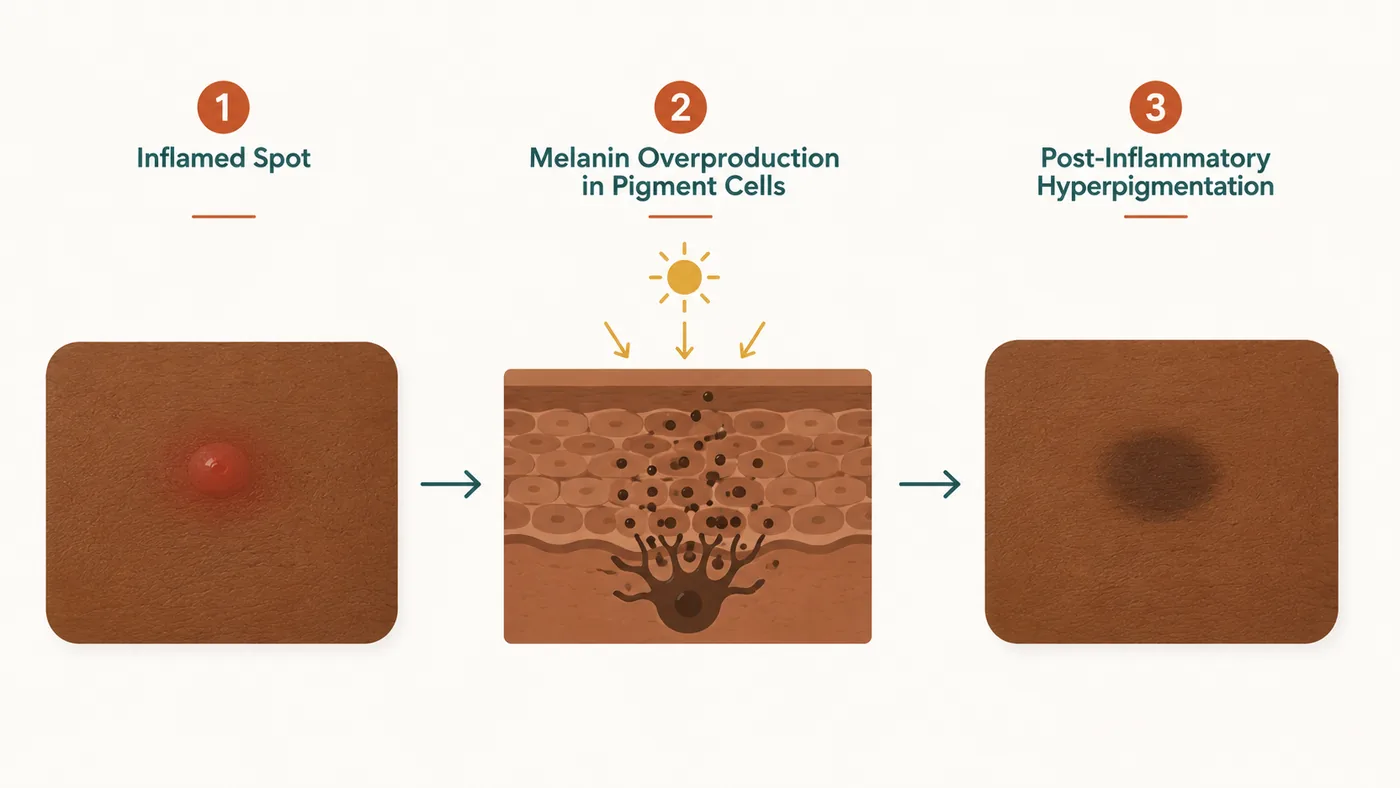
There is a specific spot you want gone, the one a pimple, a bite, or a scratch left behind months ago. Most marks like it are post-inflammatory hyperpigmentation: inflammation pushes deep skin's pigment cells into overdrive, and the excess melanin settles into a flat dark patch that fades slowly. Here is why deep skin marks so easily, the gentle ingredients that actually work, a simple routine, and the one step, daily no-cast SPF, that makes or breaks all of it.

Why deep skin is more prone to dark spots
If you have deep, Type V or Type VI skin, you have probably noticed that a single pimple, a bug bite, or even a small scratch can leave a dark mark that hangs around for months, long after the original spot has healed. That is not bad luck, and it is not a sign of unhealthy skin. It is simply how melanin-rich skin responds to being disturbed.
The pigment cells in your skin, called melanocytes, are more active in deep skin. That is what gives your skin its depth and its natural glow, and it is also what makes it tan easily. But that same reactivity has a flip side: when the skin is inflamed by anything at all, those melanocytes switch into overdrive at the site of the irritation and leave behind a flat dark patch. On fair skin the same injury might leave a red or pink mark; on deep skin it reads as brown, gray-brown, or nearly black.
This is why dark spots, not burning, are the top skin concern people with deep skin actually bring to a dermatologist. The sun does not have to redden or hurt your skin to darken it. Everyday inflammation quietly does the rest. Understanding that changes how you treat it: the goal is not to strip or bleach the skin, it is to calm inflammation, slow the overproduction of pigment, and protect the skin so existing marks can fade on their own schedule.
Post-inflammatory hyperpigmentation, explained
Most "dark spots" on deep skin are a specific thing with a specific name: post-inflammatory hyperpigmentation, usually shortened to PIH. It is the flat brown mark left after any inflammation heals, an acne breakout, an ingrown hair, eczema, a razor bump, a cut, a burn, or a picked-at blemish. It is different from a raised scar; PIH is a change in color only, and color changes can fade with time and care.
A few things make PIH on deep skin behave the way it does:
- It goes deeper. On deep skin, the excess pigment can settle not just in the surface layer but deeper in the skin, which is exactly why it takes longer to fade and why harsh treatments that only work on the surface often disappoint.
- Irritation makes it worse. Anything that inflames the skin, including overly strong acids, aggressive scrubs, or picking at a spot, can trigger a fresh round of pigment and deepen the very mark you are trying to fade. Gentleness is not optional here; it is the strategy.
- The sun re-darkens it daily. UV light and visible light both drive melanocytes to make more pigment. Every unprotected day nudges your spots darker, which is why sunscreen is treated as step one, not an afterthought.
Melasma is a related but distinct pattern of larger, symmetrical patches, often on the cheeks, forehead, or upper lip, and it is more stubborn and more hormone-driven. The ingredients below help with melasma too, but melasma in particular is worth a dermatologist's input, because it is prone to bouncing back. And because melasma is often hormone-driven, anyone pregnant or nursing should check with their doctor before starting any new active ingredient.
The ingredients that fade dark spots
You do not need a shelf of ten products. You need one or two well-chosen brighteners used consistently, plus sunscreen. The ingredients below have the best evidence for hyperpigmentation on deep skin, and the thread running through all of them is that they slow melanin production rather than strip the skin, which is exactly what deep skin needs.
1. Vitamin C
What it does: a daytime antioxidant that brightens overall tone, fades marks over time, and boosts the protection of your sunscreen. It is the classic starting brightener because it is gentle enough for most skin and multitasks.
How to use it: a serum in the morning, applied before moisturizer and sunscreen. If pure vitamin C (L-ascorbic acid) stings, gentler derivatives are easier on reactive deep skin. Start a few times a week and build up.
2. Niacinamide
What it does: one of the most forgiving brighteners there is. Niacinamide interrupts the transfer of pigment to the surface of the skin, calms inflammation, and strengthens the skin barrier. Studies show a five percent concentration can visibly reduce hyperpigmentation in about four weeks, and it plays well with almost everything.
How to use it: morning or night, and it layers happily with vitamin C (the old "they cancel out" myth has been put to rest). A great first active if your skin is sensitive.
3. Azelaic acid
What it does: a quiet overachiever for deep skin. Azelaic acid fades dark spots by blocking the enzyme that makes melanin, calms redness and breakouts, and is gentle enough for sensitive and acne-prone skin. Because it targets overactive pigment cells specifically, it tends to even tone without over-lightening healthy skin.
How to use it: once or twice daily, typically after cleansing and before moisturizer. It is one of the best-tolerated actives for PIH and melasma on deep skin.
4. Alpha arbutin
What it does: a gentle, stable brightener derived from a form of hydroquinone but far milder. It slows melanin production without the irritation risk of stronger lightening agents, which makes it a smart choice for deep skin that reacts to harsher options.
How to use it: a serum morning or night, layered under moisturizer. It pairs well with vitamin C and niacinamide in a simple routine.
5. Tranexamic acid
What it does: a newer star for stubborn pigment, especially melasma and deeper PIH. Tranexamic acid works by interrupting the signal between skin cells and pigment cells, and research finds it especially effective when paired with niacinamide or vitamin C.
How to use it: a serum once or twice daily. It is a good next step if the gentler brighteners have plateaued and your marks are proving stubborn.
What to be cautious with
Harsh scrubs and strong acids. It is tempting to think you can exfoliate a dark spot away, but aggressive physical scrubs and high-strength peels often backfire on deep skin by triggering fresh inflammation, and fresh inflammation means fresh pigment. Gentle chemical exfoliation in moderation can help, but more is not better here.
Picking and squeezing. The single most common cause of new dark spots is disturbing a healing blemish. Leaving spots alone is genuinely part of the treatment.
Piling on everything at once. Five actives layered on day one is a recipe for irritation. Add one brightener, give it several weeks, and only then consider a second.
A gentle routine that fades spots without irritating
Simplicity wins. Here is a starting framework you can adapt. The exact brands do not matter; the consistency does.
A simple morning and night routine
Morning: gentle cleanser, then a brightening serum (vitamin C, niacinamide, or alpha arbutin), then a lightweight moisturizer, then broad-spectrum SPF 30+ with no white cast. The sunscreen is non-negotiable, it is what protects everything underneath it.
Night: gentle cleanser, then your treatment active (azelaic acid or tranexamic acid work well here), then a moisturizer to keep the barrier calm. If you use a retinoid later on, this is where it goes, introduced slowly.
The rule of one: introduce a single new active at a time and give it eight to twelve weeks before you judge it. Fading dark spots is a marathon on deep skin. Consistency and sun protection beat intensity every time.
If your skin feels tight, stings, or looks red and irritated, you are pushing too hard, and irritation is what causes dark spots in the first place. Scale back to a gentle cleanser, a good moisturizer for dark skin, and sunscreen for a couple of weeks, let the barrier recover, then reintroduce one active slowly.
Why daily no-cast SPF is the whole game
Here is the part people skip, and it is the part that matters most. You can use the best brightening serum on the market, but if you are not wearing sunscreen every day, your dark spots will keep re-darkening faster than any product can fade them. Sun and even indoor visible light continuously push your pigment cells to make more melanin at the exact spots you are trying to clear.
The reason people with deep skin skip sunscreen is the white cast: an untinted mineral sunscreen leaves a gray, ashy film on deep skin, and a sunscreen you will not wear protects nothing. The good news is that no-cast formulas are easy to find now. Two categories are ideal for fading dark spots:
- Tinted mineral SPF with iron oxides. This is the standout for hyperpigmentation, because iron oxides block visible light, a proven trigger for melasma and dark spots on deep skin, and the tint cancels the gray cast at the same time. Double duty.
- Invisible chemical or hybrid SPF. These dry down completely clear, with no film, and are the easy everyday default if you prefer a weightless finish.
For a full walkthrough of the formulas that disappear on deep and brown skin, see our guides to the best sunscreen for dark skin and the best sunscreen for brown skin. Aim for at least SPF 30, broad-spectrum, applied every morning and reapplied on long sun days.
The picks
Below are the product types that fit deep, Type V to VI skin for fading dark spots. We link to Amazon searches, not single listings, so you land on current options and pricing and can choose the brand you already trust within each category.
As an Amazon Associate this site earns from qualifying purchases. Picks are grouped by what fits deep skin and its dark-spot concerns, chosen on fit, not commission. Links open a search so you see current options. This is general guidance, not medical advice.
Not sure of your Fitzpatrick type?
This guide is written for deep, Type V and VI skin, where dark spots behave the way described here. If you are not sure where you fall, the fastest way to know is to check your place on the scale. Take the free Fitzpatrick test →
When to see a dermatologist
Everything on this page is general education, not medical advice. Over-the-counter brighteners and good sun habits go a long way for typical dark spots, but some situations genuinely call for a professional. See a dermatologist if:
- A spot is changing in size, shape, or color, or looks different from your other marks. Any changing spot should be checked, full stop.
- You have new marks and are not sure why they appeared.
- Your dark spots are widespread, deeply set, or not improving after a few months of consistent, gentle care.
- You suspect melasma, which is prone to returning and often needs a tailored plan.
- You want prescription-strength options, which a dermatologist can prescribe and monitor safely for deep skin.
A dermatologist experienced with skin of color can rule out other conditions and build a plan around how deep skin actually behaves, which is worth it for anything stubborn or unclear.
Questions, answered
Why is dark skin more prone to dark spots?
Deep, Type V and VI skin has more active melanocytes, the cells that make pigment. When the skin is inflamed by a pimple, a bug bite, a scratch, or any irritation, those melanocytes overproduce melanin at the site and leave a flat dark mark called post-inflammatory hyperpigmentation, or PIH. The same reactivity that makes deep skin tan easily also makes it mark easily, which is why dark spots, not burning, are the number-one skin concern people with deep skin bring to a dermatologist.
What ingredients fade dark spots on dark skin?
The best-evidenced brightening ingredients for deep skin are vitamin C, niacinamide, azelaic acid, alpha arbutin, and tranexamic acid. They work by slowing melanin production rather than stripping the skin, which matters on deep tones because harsh exfoliation and strong acids can trigger fresh inflammation and make spots worse. Start with one gentle brightener, use it consistently, and give it eight to twelve weeks.
How long does it take to fade dark spots on dark skin?
Patience is the hard part. Surface post-inflammatory marks often lighten noticeably in eight to twelve weeks of consistent care, but deeper or older spots can take six months or longer. Deep skin holds pigment longer than fair skin, so the timeline is slower, and the most common mistake is quitting too early or piling on too many strong actives at once, which restarts the inflammation that caused the spot.
Does sunscreen really help fade dark spots?
Yes, and it is the most important step of all. Sun and even visible light darken existing spots and undo the work of every brightening serum. Without daily broad-spectrum SPF, dark spots keep re-darkening faster than any product can fade them. A tinted mineral sunscreen with iron oxides is ideal for deep skin because it blocks visible light and leaves no white cast.
Can I use vitamin C and niacinamide together on dark skin?
Yes. The old idea that vitamin C and niacinamide cancel each other out has been debunked; modern formulas pair them safely and they work well together on dark spots. A common approach is a vitamin C serum in the morning under sunscreen and niacinamide either morning or night. If your skin is sensitive, introduce one at a time so you can tell how each behaves.
When should I see a dermatologist about dark spots?
See a dermatologist if a spot is changing in size, shape, or color, if it is new and you are not sure why it appeared, if marks are widespread or not improving after a few months of consistent care, or if you want prescription-strength options. This guide is general education, not medical advice, and a professional can rule out other conditions and tailor a plan to your skin.