
Fitzpatrick skin type chart: all six types compared
One table for the whole scale. See how Type I through Type VI differ by how they burn, how they tan, their typical eye, hair, and skin descriptors, how much they freckle, and the sun protection each one needs.
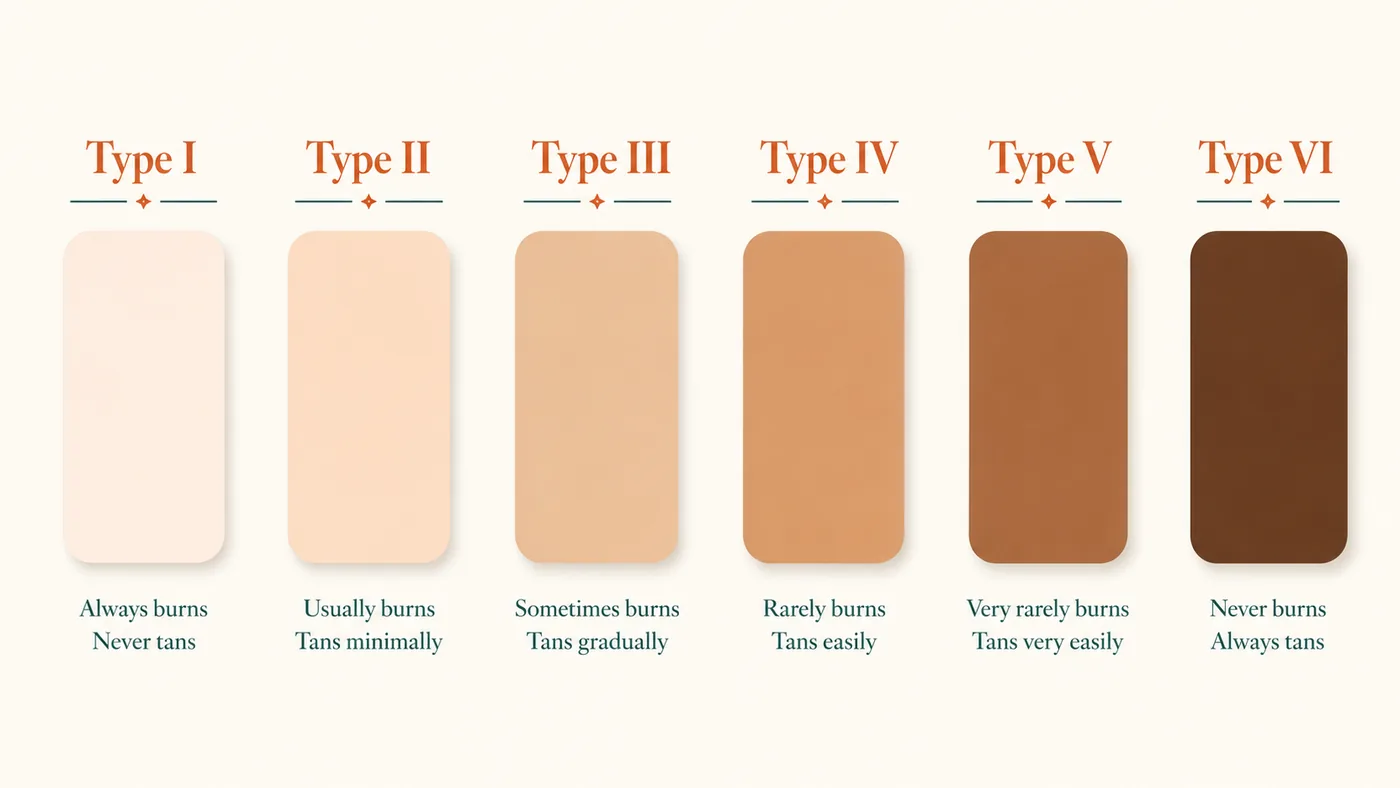
If you have ever read three different Fitzpatrick charts and come away with three slightly different answers, you are not imagining it. The six core types are standard, but every source adds its own columns and shades. This page pulls the whole scale into one chart, then explains each part so you can place yourself with confidence rather than guesswork. The fastest path is still the free Fitzpatrick test, but if you would rather read the table yourself, start here.
The scale was built by dermatologist Thomas Fitzpatrick in 1975 to predict how skin responds to ultraviolet light. It sorts everyone into six phototypes, Type I at the fair end and Type VI at the deep end, based on melanin and, above all, on how the skin burns and tans. Keep that in mind as you scan the chart: the burn-and-tan answer is the spine of the whole thing. Everything else is supporting detail.
The full comparison chart
Here are all six types side by side. Read the row that matches how your skin actually behaves in real sun, not how you wish it behaved. Each type name links to its full guide.
| Type | Typical features | Burns? | Tans? | Freckling | Recommended SPF | Care focus |
|---|---|---|---|---|---|---|
| Type I Very fair |
Pale, often blue, green, or gray eyes; red or light blonde hair | Always, easily | Never | Heavy | SPF 50, reapplied | Maximum protection; self-tanner for color |
| Type II Fair |
Fair skin; blue, gray, or hazel eyes; blonde to light brown hair | Usually | Minimally, with effort | Common | SPF 50 | High daily SPF; gradual self-tan |
| Type III Medium |
Medium skin; hazel or brown eyes; brown hair | Sometimes | Gradually, to light brown | Occasional | SPF 30 to 50 | Daily SPF; keeping tone even |
| Type IV Olive |
Olive or light-brown skin; brown eyes; dark brown hair | Rarely | Easily, to moderate brown | Rare | SPF 30, no white cast | No-cast SPF; brightening for dark spots |
| Type V Brown |
Brown skin; dark brown eyes; dark brown to black hair | Very rarely | Readily, deepens fast | Very rare | SPF 30, invisible finish | Invisible SPF; fading hyperpigmentation |
| Type VI Deeply pigmented |
Deeply pigmented skin; dark brown to black eyes and hair | Effectively never | Always, never burns first | None | SPF 30, zero cast | Zero-cast SPF; even tone and dark spots |
The SPF column is sensible starting guidance, not a rule. Dermatology bodies recommend broad-spectrum SPF 30 or higher for every type, every day. Fair types simply have less room for error, so the higher end matters more for them.
How to read the chart
People get the wrong type when they lead with appearance. A column like eye color or hair color is a clue, not the answer. Lead instead with behavior. Picture a day with real, unprotected sun exposure, the kind you would now avoid, and ask honestly what your skin did: did it go pink and sore, did it deepen to a tan, did it do both in sequence, and how fast.
That answer points you to a row. Then use the feature and freckling columns to confirm it, not to override it. If your skin burns before it tans but your hair is dark, the burn-and-tan answer wins, and you are likely lower on the scale than your hair suggests. The scale is about UV response, full stop.
One more habit that keeps people honest: judge by the skin the sun never reaches, like the inner upper arm. A current tan can push you a row or two off your true type. Base your reading on your natural, unexposed skin.
Burns and tans, the two columns that matter most
These two columns are the original heart of the scale, so it is worth slowing down on them. Burning is your skin signaling that UV has overwhelmed its defenses. Tanning is melanin rising to absorb more UV. The balance between the two is exactly what the Fitzpatrick number captures.
At the fair end, Type I burns and never gets a protective tan, which is why it carries the highest sun-damage risk and needs the most cover. Type II burns first and may scrape together a faint tan afterward. By Type III the two are roughly balanced, burning sometimes and tanning gradually, which is why so many people land in the middle and feel unsure.
At the deeper end the order flips. Type IV tans easily and only rarely burns. Type V deepens fast and burns very rarely. Type VI effectively never burns and tans without a burn phase at all. That resistance is real, but it is not immunity. Deeper skin still takes UV damage, just expressed more as uneven tone and dark spots than as a visible burn, which is why every row of the chart still has an SPF.
Not sure which way you lean?
If the burn-and-tan columns feel like a toss-up between two rows, the free Fitzpatrick test weighs all eight signals at once and breaks the tie for you in under a minute. You can also work through it by hand with our guide to finding your type.
Eye, hair, and skin descriptors
The feature columns are the part of the chart most likely to mislead, so use them gently. They reflect the genetics that often travel with low or high melanin, fair skin tends to come with light eyes and light hair, deep skin with dark eyes and dark hair, but the pairing is a tendency, not a law.
Plenty of people break the mold: dark hair on fair, easily burning skin, or light eyes on a deeper tan-readily complexion. When your features and your burn-and-tan answer disagree, trust the burn-and-tan answer. The descriptors are there to confirm a type you have already found, not to assign one. Read them as a sanity check, then move on.
Freckling and recommended SPF
Freckling is a useful tiebreaker at the fair end of the chart. Heavy freckling that appears or darkens with sun is a strong marker of Type I or Type II, where melanin is patchy and reactive. As you move toward the deeper types, freckling fades as a signal and the chart relies more on tanning behavior. If you freckle readily, you almost certainly sit in the top half of the scale.
The recommended-SPF column deserves a plain caveat. The exact number varies between charts because it is practical advice layered on top of the original scale, not part of the 1975 definition. The honest version is simple: every type benefits from daily broad-spectrum SPF 30 or higher. Fair types have the least margin and the most to gain from the higher end and from reapplying, while deeper types still need daily SPF, often one chosen specifically to leave no white cast. Treat the chart's number as a floor, not a ceiling.
Tone words mapped to types
Most people describe their skin with everyday words, not type numbers. If you call yourself fair, olive, or deep, this smaller table maps those words onto the most likely Fitzpatrick type. Use it as a shortcut into the main chart, then confirm with the burn-and-tan columns, because a tone word describes how skin looks while the type describes how it behaves.
| If you describe your skin as... | Most likely type | What confirms it |
|---|---|---|
| Pale, porcelain, very fair | Type I | Burns every time, never tans, often freckles |
| Fair, light | Type II | Burns first, tans only lightly afterward |
| Medium, light beige, golden | Type III | Burns sometimes, then tans gradually |
| Olive, tan, light brown | Type IV | Tans easily, rarely burns, warm undertone |
| Brown | Type V | Very rarely burns, deepens quickly |
| Deep, dark, deeply pigmented | Type VI | Effectively never burns, tans without a burn phase |
Tone words overlap, so a single word can sit on the border between two types. The word "tan," for example, can describe either a naturally Type IV complexion or a Type III that has tanned. When in doubt, the burn-and-tan answer decides.
A guide, not a diagnosis
This chart is an educational tool, and it is genuinely useful for one thing: helping you choose sun care and products that fit how your skin behaves. It is not a medical assessment. The Fitzpatrick scale was never meant to diagnose disease, measure beauty, or stand in for a doctor's judgment.
A few honest limits worth naming. The original scale was built around lighter skin and has been criticized for being less precise across the deepest tones, where Type V and Type VI cover a wide range of real complexions. It says nothing about your specific risk for any condition, because genetics, total lifetime sun exposure, and family history all matter alongside your type. And it can shift in appearance with a tan even though your underlying type does not change.
So use the chart to shop smarter and protect your skin, and see a dermatologist for anything medical, any new or changing mole, spot, or patch. Knowing your type is a starting point, not a verdict.
Want the deeper background?
For where the scale came from, how it is used in clinics, and its strengths and blind spots, read what the Fitzpatrick scale is. To pin down your own row, take the free test or follow the find-your-type method.
Chart questions, answered
What is the Fitzpatrick skin type chart?
It is a table that sorts skin into six phototypes, Type I to Type VI, by how it reacts to the sun. Each row pairs a type with its typical eye, hair, and skin descriptors, whether it burns or tans, how much it freckles, and the level of sun protection it needs. It was created by dermatologist Thomas Fitzpatrick in 1975 to predict UV sensitivity, not to rank appearance.
How do I read the chart to find my type?
Start with the burn-and-tan columns, since they carry the most weight. Find the row that matches how your skin behaves after real sun exposure: does it burn, tan, or both, and how quickly. Then check the feature descriptors and freckling to confirm. If two rows feel close, the burn-and-tan answer breaks the tie.
Is the Fitzpatrick chart the same as a skin-tone chart?
No. A skin-tone chart describes how skin looks, often by shade swatch or undertone. The Fitzpatrick chart describes how skin behaves in the sun. They usually line up, but two people with a similar tone can sit on different rows because one burns and the other tans, which is exactly what the Fitzpatrick scale measures.
Why do some charts skip freckling or change the SPF numbers?
The core six types are standard, but the extra columns vary by source because they are practical add-ons rather than part of the original 1975 definition. Freckling and recommended SPF are widely used guidance, not fixed rules. Treat any single number as a sensible starting point, then adjust for your own burn history and how much sun you actually get.
Can the chart tell me my risk of skin cancer?
Not on its own. Lower-numbered types burn more easily and so face higher sun-damage risk on average, but the chart is an educational guide, not a diagnosis. Genetics, total lifetime sun exposure, family history, and other factors all matter. For any mole, spot, or skin concern, see a dermatologist who can assess your skin in person.
Sources
- Fitzpatrick TB. The validity and practicality of sun-reactive skin types I through VI. Archives of Dermatology, 1988.
- American Academy of Dermatology, sunscreen FAQs.
- Skin Cancer Foundation, skin cancer in people of color.