
Fitzpatrick Type I: very fair skin that always burns
If you burn after barely any time outside, watch sun damage stack up season after season, and worry about lines and spots showing up early, this is your page. Type I is the fairest point on the Fitzpatrick scale: pale or porcelain skin that always burns and never tans, often paired with light eyes, red or blonde hair, and freckles. For this type, protection is not one step in the routine; it is the routine. Here is how to know if you are Type I and how to build sun care that fits.
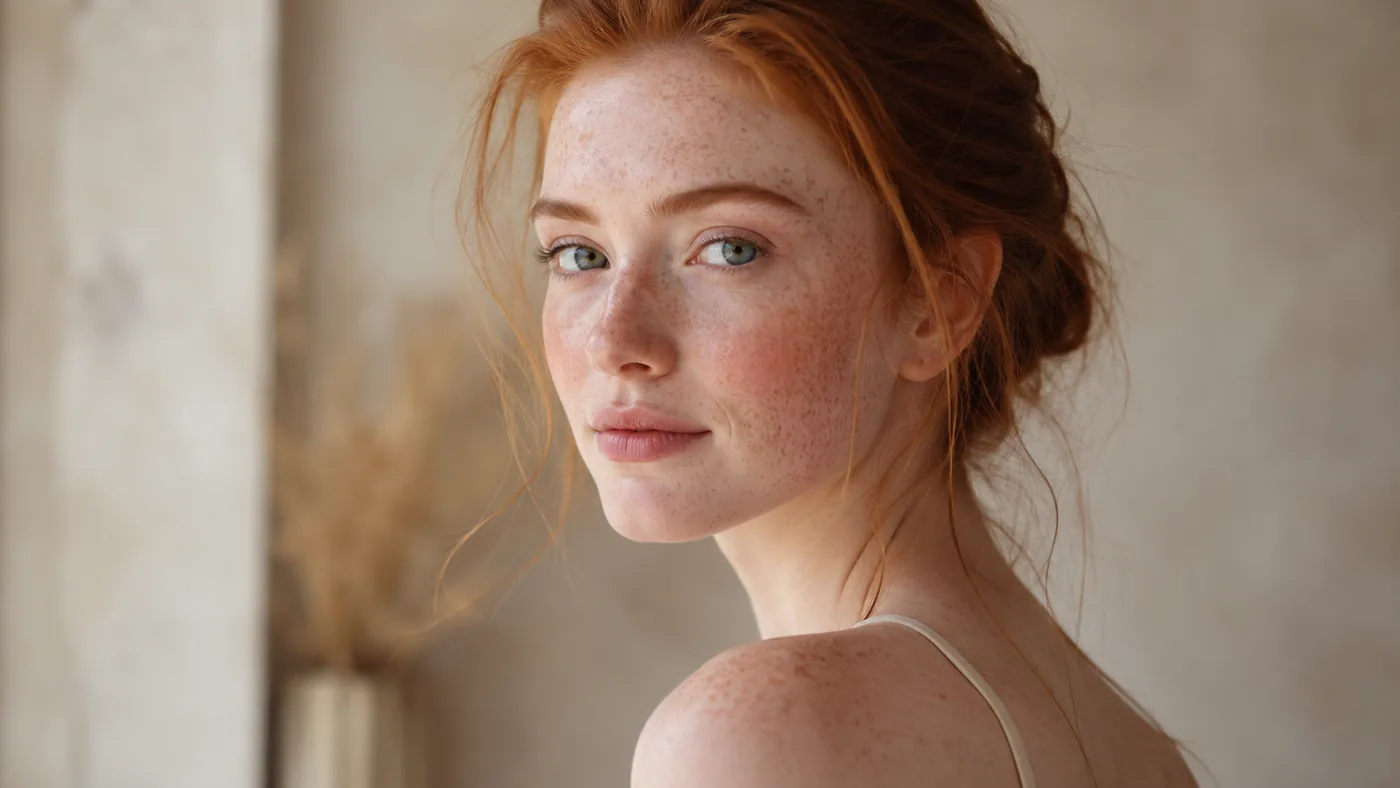
How to know if you are Type I
Fitzpatrick Type I is the very fair, or porcelain, end of the scale. The Fitzpatrick system, created by dermatologist Thomas Fitzpatrick in 1975, sorts skin into six phototypes (the clinical term for skin type) by how it behaves in the sun, and Type I is the one with the least protective pigment of all. If you have ever been told you are "fair" your whole life and have the sunburn history to match, this is probably you.
The clearest sign is your sun reaction, which we cover in the next section, but the physical tells are easy to spot. Most Type I people have several of these:
- Skin color: pale, ivory, or porcelain, often with a cool or pink undertone. The skin the sun never reaches (the inside of your upper arm) looks almost white.
- Hair: naturally red, strawberry blonde, or very light blonde is the classic pairing, though Type I can come with light-brown hair too.
- Eyes: usually light, blue, gray, or green.
- Freckles: often present, sometimes heavy, especially across the nose and shoulders, and they tend to multiply after any sun.
- Reactivity: the skin flushes easily, may be prone to rosacea, and reddens fast in heat or sun.
You do not need every box ticked. The deciding factor is always how your skin reacts, not your hair color. If you burn fast and never get a real tan, you are Type I even if your hair is brown. If you tan even a little, you are more likely Type II, the fair-but-tans-faintly type next door. Not sure where you land? You can take the free Fitzpatrick test in under a minute.
How Type I skin reacts to the sun
This is the heart of it. A tan is your skin producing extra melanin to shield itself from UV. Type I skin barely makes that protective melanin, so instead of tanning, it burns. There is no "base tan" to build and no safe middle ground, the skin goes from pale to pink to burnt with very little in between.
In practice that means a Type I person can start to burn in as little as 5 to 15 minutes of strong midday sun, and faster still near water, in snow, or at altitude, where UV bounces and intensifies. Any color that shows up afterward is not a tan; it is sunburn fading to a slightly less angry shade, with the damage already done underneath.
Because Type I has the least natural defense, it also carries the highest sun-damage and skin-cancer risk of any phototype, which is exactly why dermatologists are so insistent about sun protection for fair skin. The flip side is reassuring: with consistent protection, Type I skin can stay healthy, clear, and even-toned for decades. The goal is not to avoid the outdoors, it is to make protection automatic so the sun stops being a problem.
A quick word on vitamin D
People sometimes skip sunscreen to "get their vitamin D." For Type I skin that trade is a bad deal, because you burn long before you bank much. A daily dietary source or a supplement is a far safer way to keep vitamin D up, and worth asking your doctor about, while you keep your skin protected.
The daily routine for Type I skin
The Type I routine is built around one idea: layer protection so no single thing has to do all the work. Sunscreen is the foundation, but clothing, shade, and timing each take a share of the load.
1. Broad-spectrum SPF 50, every day
This is non-negotiable for Type I. Use a broad-spectrum (UVA and UVB) sunscreen rated SPF 50, applied every morning to your face, ears, neck, and the backs of your hands, even on gray days and in winter. Up to 80 percent of UV gets through cloud, and UVA, the band that drives aging and damage, is fairly constant year round and even passes through glass. Apply a generous amount (a good rule is about two finger-lengths for the face and neck) and reapply every two hours when you are outdoors.
2. UPF clothing and a wide-brim hat
Fabric is the most reliable sunscreen there is, because it never needs reapplying. On bright days, a UPF-rated long-sleeve layer, a wide-brim hat, and UV-blocking sunglasses do more for Type I skin than any cream alone. UPF 50 clothing blocks about 98 percent of UV, and it covers the spots people always forget to re-cream.
3. Shade and timing
UV peaks between roughly 10am and 4pm. Type I skin benefits most from shifting outdoor time to early morning or late afternoon, and from seeking shade during those peak hours. None of this means hiding indoors; it means stacking small habits so the few minutes you do spend in strong sun are not the unprotected ones.
4. Color from a bottle, not the sun
If you like the look of a tan, a gradual self-tanner is the only safe way for Type I skin to get there. Done right it gives a believable glow with zero UV, and it is the most important swap a fair-skinned person can make. We go deeper on choosing one in the next section, and in our full best self-tanner for pale skin guide.
5. After-sun and aftercare
Even careful Type I skin catches the odd burn. A cooling after-sun gel with aloe, and keeping the skin well moisturized, helps it recover and reduces peeling. If a burn is severe, blistered, or comes with feeling unwell, that is a reason to see a doctor.
Ingredients and products to look for
You do not need a ten-step routine. For Type I skin, four product types carry almost all the value: a high-SPF mineral sunscreen, a UPF layer, a gradual self-tanner made for fair skin, and an after-sun. Here is what to look for in each.
Broad-spectrum mineral SPF 50
Look for the words "broad spectrum," an SPF of 50, and, if your skin is reactive or rosacea-prone, a mineral filter (zinc oxide or titanium dioxide). Mineral formulas sit on the surface and tend to soothe rather than sting, which suits sensitive fair skin. If you find mineral formulas leave a cast, a modern hybrid or chemical SPF 50 that rubs in clear is fine too. The best sunscreen is the one you will happily reapply.
Gradual self-tanner for fair skin
The trick to a natural result on very pale skin is going slow and low. Choose a gradual lotion or a "light" or "fair" mousse with a lower DHA level (roughly 1 to 3 percent), and ideally one with a green or olive tone guide, which counteracts the orange that fair skin is prone to. Build color over a few applications rather than chasing a deep tan in one coat. We cover specific formats in the self-tanner for pale skin guide.
UPF clothing
Look for a stated UPF rating (UPF 50 is ideal), light breathable fabric for summer, and good coverage: long sleeves, a wide brim, and wrap sunglasses. A packable UPF hoodie or sun shirt is the easiest win for anyone who burns this fast.
After-sun care
An aloe-based after-sun gel cools a flush and helps the skin recover. Fragrance-free is kinder to reactive skin. Keep one on hand for the days protection slips.
What to avoid with Type I skin
A few habits do real harm to Type I skin, and a couple of product mistakes are worth dodging:
- Chasing a tan in the sun. Type I skin cannot tan safely. Sun exposure for color only delivers burns and long-term damage, so this is the habit to drop first.
- Tanning beds. Worse than sun, not better. Sunbeds deliver concentrated UV and raise skin-cancer risk sharply, especially for fair skin. A self-tanner gets you the look with none of the cost.
- Skipping SPF on "low sun" days. Cloud, winter, and time near windows still deliver UVA. For Type I, daily is the only setting that works.
- Harsh, high-DHA self-tan. Strong, dark, "instant" self-tanners are the fastest route to orange streaks on pale skin. Go gradual and light instead.
- Applying too little sunscreen. Most people use about a quarter of what they need, which quietly cuts the real SPF in half. Be generous, and reapply.
Products that work for Type I
As an Amazon Associate this site earns from qualifying purchases. Picks are chosen on fit for Type I skin, not on commission. Links go to Amazon search results so you can compare current options and prices.
Want the deeper dive on getting believable color without the orange? Our best self-tanner for pale skin guide compares formats, shades, and application for Type I and Type II skin specifically.
Type I questions, answered
Can Fitzpatrick Type I skin ever get a tan?
Not in a meaningful or safe way. Type I skin lacks the protective melanin response that produces a tan, so sun exposure causes a burn rather than color. Any color you see is sunburn or sun damage. The way to look bronzed without harm is a gradual self-tanner, which adds color to the skin surface without any UV exposure.
How long can Type I skin be in the sun before burning?
Often just 5 to 15 minutes of midday summer sun is enough to start a burn on unprotected Type I skin, and sometimes less at high altitude, near water, or in snow. This is why a daily SPF habit matters more for Type I than for any other phototype, rather than only on beach days.
Is mineral or chemical sunscreen better for very fair skin?
Both can work if they are broad spectrum and SPF 50. Mineral filters (zinc oxide, titanium dioxide) suit reactive or rosacea-prone fair skin because they sit on top and tend to soothe. Modern chemical or hybrid formulas often feel lighter and rub in clearer. The most important thing is using enough of whichever one you will actually reapply.
Will self-tanner turn very pale skin orange?
It can if you pick a formula that is too strong. For Type I skin, choose a gradual lotion or a light or fair-shade mousse with a lower DHA level, ideally one with a green or olive tone guide that counteracts orange. Build color over a few applications instead of going dark in one coat, and exfoliate first so it grips evenly.
Does Type I skin still need sunscreen on cloudy days or in winter?
Yes. Up to about 80 percent of UV passes through clouds, and UVA, the aging and damage band, is fairly steady year round and even comes through windows. Because Type I skin has so little natural defense, a daily broad-spectrum SPF on the face and hands is worth keeping up all year, not just in summer.
What is the difference between Type I and Type II skin?
Both are fair and burn easily, but Type I always burns and never tans, while Type II usually burns yet can build a very faint tan with repeated exposure, at a cost to the skin. Type I more often has red or strawberry-blonde hair, light eyes, and heavy freckling. If you tan even slightly, you are likely Type II.
Sources
- Fitzpatrick TB. The validity and practicality of sun-reactive skin types I through VI. Archives of Dermatology, 1988. PubMed
- American Academy of Dermatology. Sunscreen FAQs