
How to find your Fitzpatrick skin type at home
You do not need a clinic or a fresh sunburn to find your type. The most reliable home method is a burn-history recall: remember how your skin reacts to strong sun, cross-check four features you can see in a mirror, and land on a Type I through VI.
The Fitzpatrick scale sorts skin into six phototypes (the clinical term for skin type) by one thing above all: how it behaves in ultraviolet light. Type I always burns and never tans. Type VI effectively never burns. Everyone else sits somewhere in between. Because the scale is built on sun reaction, the best way to find your own type at home is to ask your skin what it has already done in the sun, then sanity-check that answer against a few visible features.
This guide walks the same self-assessment a dermatologist uses, just in plain language. It takes a few minutes, costs nothing, and asks you to recall, not to repeat, a sunburn. If you would rather have the questions scored for you, you can jump straight to the Fitzpatrick test and come back to read why each answer matters.
Why burn history beats matching a swatch
It is tempting to find your type by holding your arm next to a row of skin-tone swatches and picking the closest one. That is a fine starting point, but it can mislead you, because two people with a near-identical tone can react to the sun completely differently. One tans smoothly; the other goes pink in twenty minutes. The Fitzpatrick scale cares about the reaction, not the shade.
So the anchor of the home method is memory. Think back to a time your skin met strong summer sun with no sunscreen on: a beach day before you remembered to reapply, a long afternoon in the garden, a walk that ran longer than planned. Two windows matter most.
- The first 30 to 60 minutes. What happened early, before a tan could possibly form? Did your skin start to sting or turn pink almost at once, or did it stay comfortable?
- After a season of sun. By the end of a sunny summer, where did your skin land? Did it build a real tan, a faint one, or none at all? Did it just keep burning and peeling?
Those two answers, the early burn and the eventual tan, are the heart of the whole scale. Hold them in mind as you go through the steps below.
Step 1: run the burn-history method
Answer these two questions honestly, based on unprotected sun and your natural, untanned skin. Pick the line that fits best.
How easily does your skin burn?
- Always, quickly, and it hurts. Pink or red within the first half hour, often sore or peeling later. Points toward Type I or II.
- Sometimes, if I overdo it. You can catch a burn on a long, careless day, but a normal day outdoors is usually fine. Points toward Type III or IV.
- Rarely or never. You do not really remember the last time you burned. Points toward Type V or VI.
How readily does your skin tan?
- It does not, or it goes straight to freckles. Burns instead of tanning. Type I, sometimes II.
- It tans slowly and lightly after it has finished being pink. Type II or III.
- It tans easily to a clear brown without much burning. Type IV.
- It deepens readily and rarely shows a burn at all. Type V or VI.
Step 2: check the four features
Now confirm that burn-history read against four things you can observe directly. None of these alone decides your type, but together they should agree with what your skin does in the sun. If they clash badly, your sun reaction wins (see the ambiguous-result section).
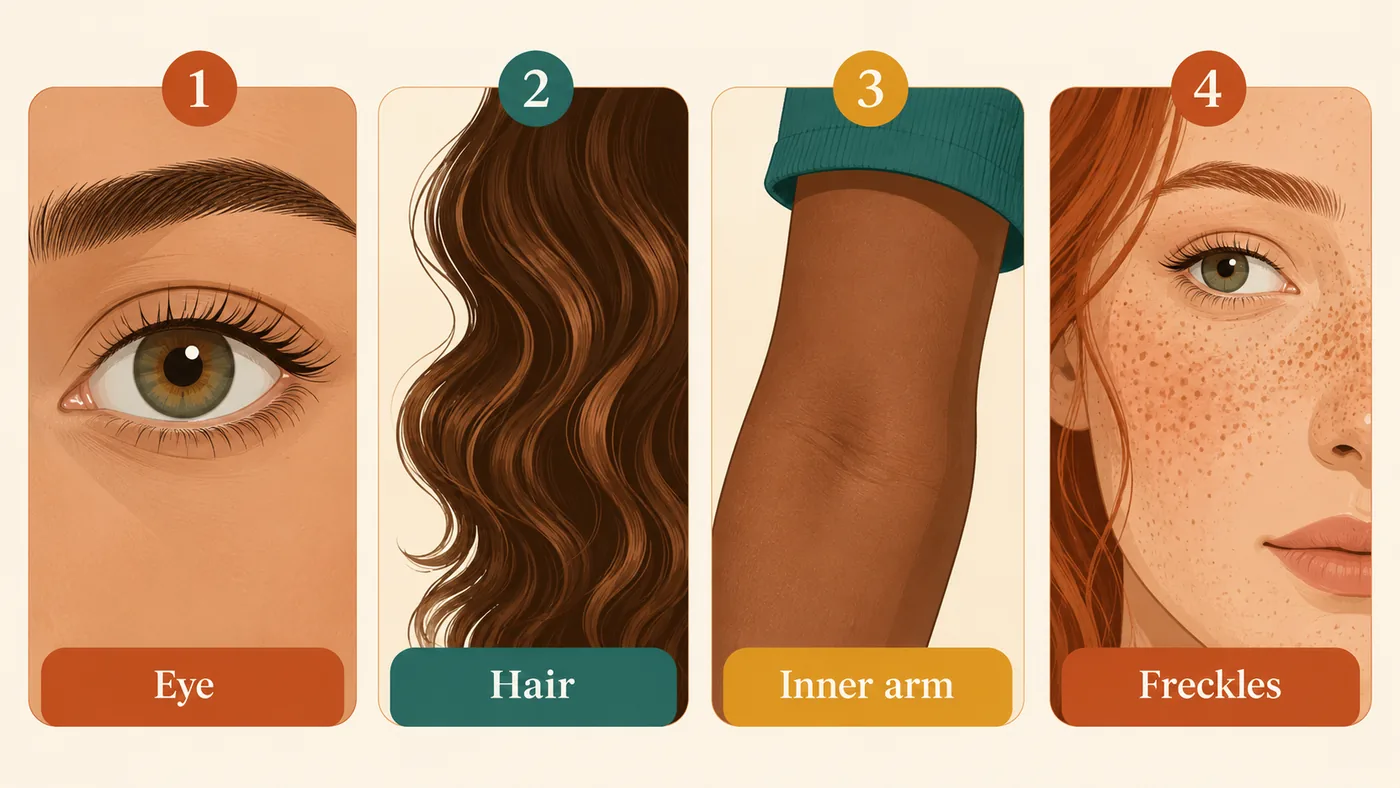
1. Eye color
Look at your natural eye color in good light. Light blue, gray, or green eyes lean fairer (Type I or II). Hazel and light brown sit in the middle (Type III or IV). Dark brown eyes lean deeper (Type V or VI). Eye color is a genetic clue to how much protective pigment your skin tends to carry.
2. Natural hair color
Use the color your hair was before any dye or sun-lightening, ideally the shade from childhood. Red or light blonde points to Type I or II. Darker blonde to light brown points to Type III. Mid to dark brown points to Type IV. Dark brown to black points to Type V or VI.
3. The color of skin the sun never reaches
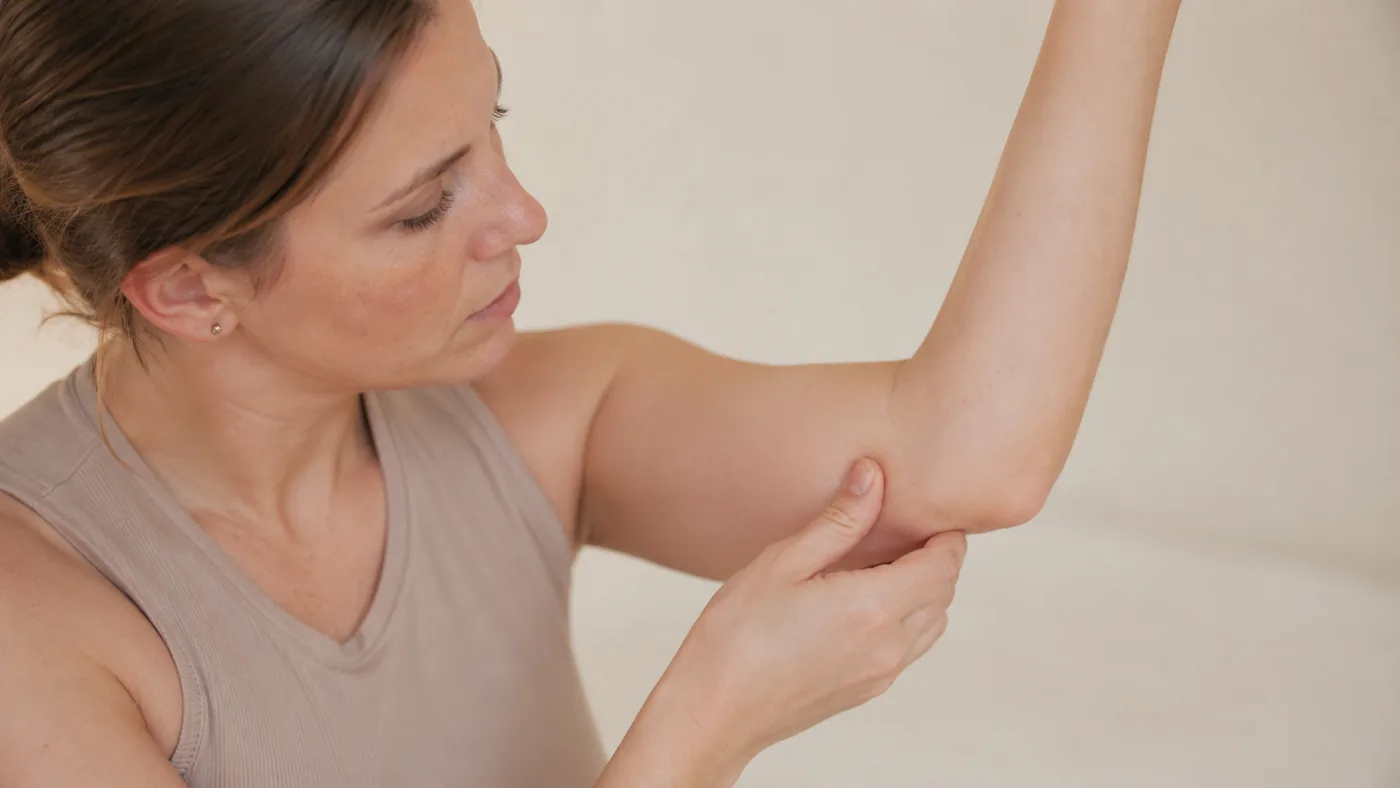
This is the most useful single feature, and it is why the lead image shows an inner arm. Turn your forearm over and look at the skin on the inside, near the elbow, or check your upper inner arm or the skin under a watch. That area is rarely exposed, so it shows your true baseline before any tan. Very pale, almost translucent, sometimes with visible veins, points to Type I. Pale points to Type II. Beige or light olive to Type III. Olive or light brown to Type IV. Brown to Type V. Deep brown to Type VI.
4. Freckling
How much do you freckle in the sun? Heavy freckling is strongly associated with the fairest types (Type I, often II), because freckles are clusters of pigment in skin that otherwise struggles to tan evenly. Some freckling fits Type II or III. Little to none is typical from Type IV downward.
Step 3: put it together into a Type I to VI
You now have two reads: what your skin does in the sun, and what your features suggest. In most people they agree, and you can name your type with confidence. Use this quick map to settle on one.
| Type | Burns | Tans | Typical features |
|---|---|---|---|
| Type I | Always, fast | Never | Very pale skin, light eyes, red or blonde hair, freckles |
| Type II | Easily | Lightly, with effort | Fair skin, often light eyes and hair, some freckling |
| Type III | Sometimes | Gradually, to light brown | Beige to light olive skin, varied eyes and hair |
| Type IV | Rarely | Easily, to brown | Olive or light-brown skin, dark hair and eyes |
| Type V | Very rarely | Readily, deepens fast | Brown skin, dark hair and eyes |
| Type VI | Effectively never | Deepens, rarely visible burn | Deeply pigmented skin, dark hair and eyes |
Read across the row that matches your burn-and-tan answer first, then check that the features column is in the right neighborhood. If both line up, that is your type. For the full side-by-side reference, the Fitzpatrick type chart lays out all six at once with their sun-care needs, and the scale explainer covers where the system came from.
Step 4: confirm with the on-site quiz
Doing this by hand is a great way to understand why you are a given type, but it is easy to weigh the answers unevenly in your head. The quickest way to check yourself is to let the questions be scored for you. The on-site test asks the same eight things, eye color, hair color, unexposed skin color, freckling, how you burn, how you tan, and a couple of sensitivity questions, then adds them up the way the scale was designed to be added.
Not sure? Take the Fitzpatrick test
It takes under a minute, runs entirely in your browser, stores nothing, and gives you a Type I to VI plus a sun-care routine that fits it. If your hand-counted answer and the quiz agree, you can trust your type. Take the free Fitzpatrick test →
When your result is ambiguous
Plenty of people do not land cleanly on one type, and that is normal. Two situations come up most often.
Your features and your sun reaction disagree. Maybe you have the pale skin and light eyes of a Type II, but you tan more readily than that would suggest. When the two reads pull apart, follow your skin, not the mirror. The scale exists to describe sun reaction, so how you actually burn and tan is the deciding vote. Eye and hair color are supporting evidence, not the verdict.
You sit right between two types. If you genuinely cannot tell whether you are Type II or Type III, or III versus IV, do not agonize. Choose the lower, fairer number for any sun-care decision. Protecting as the fairer type means a little more SPF or a little more shade than you strictly needed, which costs you nothing. Under-protecting as the deeper type means a burn you could have avoided. When in doubt, round toward caution.
One more source of confusion: a current tan. If you assess yourself in late summer with a tan on, you may read a type or two deeper than you really are. Always judge by your natural, unexposed skin and by how that untanned skin first reacts, not by how brown your arms happen to be today.
When to see a dermatologist instead
A home Fitzpatrick check is for choosing sun care and understanding your skin. It is educational, not a diagnosis. There are times to skip the self-assessment and see a professional.
- A mole or spot that is new, changing, growing, or has an irregular border or color.
- A sunburn that blisters, or repeated easy burning despite care.
- A personal or family history of skin cancer, or many atypical moles.
- Persistent dark patches, melasma, or pigment changes you want treated.
- Any skin concern at all that worries you, whatever your type.
A dermatologist can also confirm your phototype in person if you need it documented for a treatment, a laser session, or a procedure where the setting depends on your type. For everyday sun care, though, the home method and the quiz are plenty to get you choosing the right protection.
Once you know your number, the next move is matching it to a routine. Each type has its own guide: very fair Type I and Type II, medium Type III, olive Type IV, brown Type V, and deep Type VI. Each one walks through the SPF, the common mistakes, and the products that actually fit that skin.
Sources
- Fitzpatrick TB. The validity and practicality of sun-reactive skin types I through VI. Archives of Dermatology, 1988.
- American Academy of Dermatology, sunscreen FAQs.